
Starting August 2, 2026, Article 50 of the European Union AI Act came into effect. This obligates companies and organizations to clearly label published texts that were created or translated using artificial intelligence. The new requirement also applies to machine-translated texts. For machine-generated or machine-translated content, an icon indicating this must be placed next to the text. The European Union offers suitable notification icons (in SVG and PNG formats) free of charge.
Labeling is mandatory for texts on matters of public interest. This includes, e.g.: politics, elections, public policy, healthcare, the environment, law, economy, science, education, and security. This requirement does not generally apply to marketing content. However, it may apply to social media posts if they convey important information to the public.
Checklist questions to answer:
If you answered “yes” to all five, the text should include an artificial intelligence label (AI icon).
See the example below in an AI-generated image.
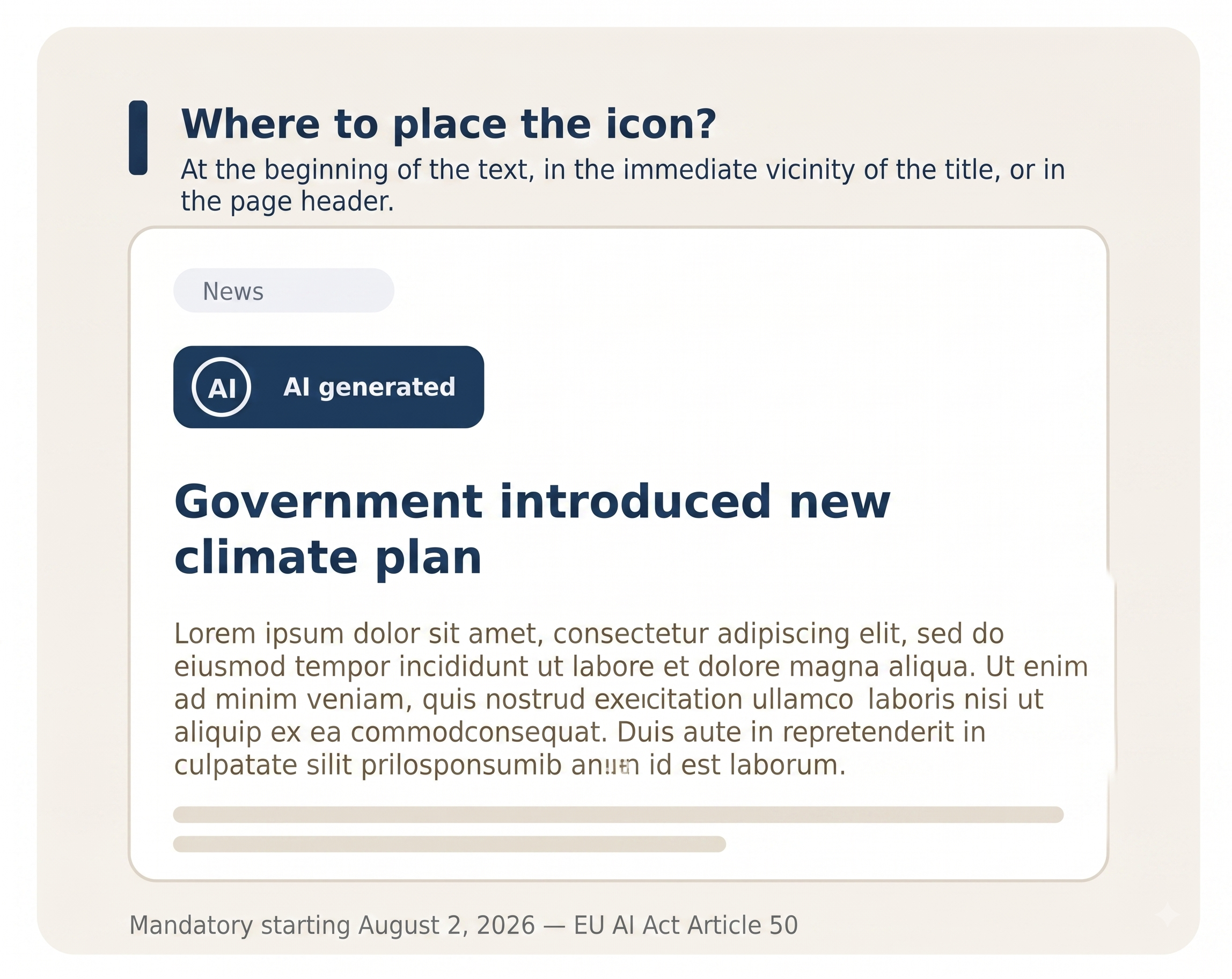
Adding an AI label is not necessary if the content is marketing-related or if the machine-generated or translated text undergoes thorough editing before publishing.
Labeling is not necessary if the text is reviewed before publication by a competent person who has strong domain knowledge and the authority to stop publication, and the review process is documented. This means that if the text is edited by a professional translator, editor, or subject matter expert, labeling is not needed.
Professional associations gain an effective tool against organizations that publish machine-translated texts without human review. Fines may be imposed for ignoring the rules. For more information, consult the official European Union website.
Need help reviewing machine-generated texts?
Send your texts to us: interlex@interlex.ee. Our experts will review them.